Why the way you speak to yourself matters
 Biddy Messchaert
Research explains why we are mean to ourselves and that we can change it. Dive into self talk and its effect with me.
Hi, I’m Biddy. A yoga therapist, teacher and teacher trainer. In these articles, I talk about my work and the things I discover, see and notice. The things I am passionate about or surprised by.
This article is also available as a podcast! Listen here:
One of the reasons I love my work as a Yoga Teacher and Therapist is that I get to meet a variety of people that are all very diverse. Granted they have a few things in common, like loving yoga and choosing to practice it in classes, retreats, or teacher trainings. At the same time their ages range from early twenties to 70s. They come from different ethnicities, life paths, and very diverse lives lived. Entrepreneurs, carers, mothers, grandmothers, people transitioning gender, people who chose not to have children. People in recovery. People looking for palliative care. People under intense stress, carrying immense responsibilities. People who could not stop moving and doing, and people who were so tired that we practiced online from the comfort of their bed or couch.
These diverse and beautiful people would all have one more thing in common. They are exceptional at showing kindness, compassion and love to others. So much so, that sometimes, they will place their own well-being dead last, always putting that of others ahead of their own.
They find it so much easier to be kind to others than to themselves. Some can whisper to themselves that they are awesome – something people who come to my classes might have been asked to do at some point. Others stiffen or break out in laughter at even the thought of it.
Why are we so hard on ourselves?
When I needed to choose a topic for my final report before graduating as a yoga therapist, I just knew that this had to be it. It was the one common denominator in all my sessions. The red thread that had started to show itself from the beginning of my case studies. Maybe even from the moment I started teaching my first yoga classes. I started to recognize how far some people are willing to push themselves, and judge themselves when they don’t, myself included.
One of the reasons this topic speaks to me is that I recognize myself in my clients. I have been a carer for my loved ones. I have put my life on hold, knowing that I only had limited time left with the people I love. I chose to put my energy where I thought it was most needed and more than once did I ignore the signals my body was giving me. When my energy started to run low, I would get annoyed with myself. I would tell myself to just keep going. Push through. For me too, it was easier to show that kindness to others than to myself.
That is why it doesn’t surprise me that this topic meets resistance almost everywhere I introduce it. After all, I resisted it myself for so long. I would even take pride in being hard on myself. Wasn’t that what we, women were supposed to do? Push ourselves, show that we can do everything. In our society, it is actually something that is celebrated, seen as a positive trait.
Looking around my classes, retreats, and lectures I see the kindest, most compassionate people. They cheer on the other people in the room, the stories they tell illustrate how they support their loved ones. The moment they turn their attention to themselves, that compassion shifts. Sometimes the voice of compassion is still there, but seemingly in dialogue with an inner critic. Other times that voice has simply left the building to make space for the voice of a bully. I have seen and heard clients and students say extremely harsh and sometimes even mean things to themselves. I know, this still doesn’t answer the question about why we do it, but I am getting there, bear with me.
So how does self talk work?
The last thing I had to do after my three years of training at The Yoga Therapy Institute was make my final report. When making the video for my final submission before graduating, I went through relevant research, read books, and listened to podcasts. I talked to my therapy clients and I asked them to fill out a questionnaire.
What I discovered makes so much sense: our self talk is self protection. If a lightbulb went off above your head, I’m with you. I felt the light switch on when I understood this. It’s our primal survival instinct that makes us look at our own behavior and judge it. In the beginning of time, we needed others to have a better chance of survival. When under attack by bears, tigers, or other people, living in a community increases our chances of survival. However, to be protected by others, we needed to be accepted by them. That meant that we needed to perform the tasks we were given well, we needed to be liked, we needed to be seen as smart, funny, valuable – at least enough to be allowed the protection of the community we lived in.
So if we did our job poorly, we would judge ourselves critically knowing that it could threaten our livelihood. While the world has changed since the beginning of mankind, and we might not face the same dangers as we did before, our instinct has not.
I want to point out that I am writing this from a very privileged point of view. I am aware that in other parts of our world, people are not as lucky as I have been, and too many people are still judged for looking, believing, or being different from what others consider the norm. But even for the lucky among us who fit the mold, our survival instinct is not something we can just turn off.
Even for the privileged the stress of being accepted is relevant, still. We need to perform our job well if we want to be paid. We need to pass our exams if we want to graduate. We need to show socially accepted behavior to be part of our social circles. While we may no longer fear for our life when we make a mistake, we know that that mistake will influence how others perceive us.
So the desire to be accepted is still a very understandable concern. At the same time, common sense tells us that we will not do everything we do perfectly. Imperfection is a part of being human. It’s the self talk that might come after a mistake that we can change.
A simple example: Losing balance in tree pose
Let me share an example you might recognize. Students drop out of a balance pose all the time, as they should. Stay in a tree pose long enough, at some point you will have to step out, I think we can all agree on that.
Many of us have the idea, however, that we are supposed to be able to hold our tree pose for a certain amount of time. The question is: what happens when we need to step out sooner than we think we should? Can you laugh? Can you be proud of how long you stayed in, or how you experimented in the pose? Maybe notice the muscles you activated to come in and out of the pose? Or are you softly whispering to yourself “I should be able to do this better.” “Look at my neighbor, she's still in the pose. Why can’t I do this?” “I can’t even do this, wtf.” These are all things I have heard in classes. I can only imagine the self talk that stays in people’s heads and does not get spoken out loud. This is a seemingly small thing, but it does show us how we can judge ourselves and talk to ourselves.
Why this matters: The effect of self talk on your nervous system
Now that you know what I mean by self talk, let’s look at how it affects us. We are all born with a supercomputer inside us that helps us react, navigate, breathe, think, and live: our nervous system. Our nervous system thinks in black and white. Perceived danger is processed the same way as in-your-face danger like a tiger running towards us. Because socially acceptable behavior is a survival instinct, talking to ourselves harshly, telling ourselves we’re dumb, or not good at anything is perceived as danger by our nervous system.
When our nervous system senses danger, our stress levels rise causing our hearts to beat faster, our breathing to become shallow, and muscles in our body to tense up in preparation to fight, freeze or flight. I’m going to assume that you are aware that prolonged stress is not healthy. So when our self talk is harsh continuously, our stress levels will be high continuously as well. We might not notice this, as it doesn’t rise to the level of preparing to run from a tiger. But what research shows is that constant raised levels of stress make it harder for us to rest or relax.
How do we change negative self talk?
I wish I could give you a secret code to stop being unkind to yourself right now. If only it were that easy! The way we speak to ourselves is often something we do without thinking about it, which makes it hard to change. Hard, but not impossible. What can be a good start is to think back: choose a moment something went wrong. That time you forgot something when grocery shopping, or you made a mistake at work. Maybe that time you didn’t stay in your tree pose as long as you thought you should. Can you remember how you reacted to that? Some of us might say “Shit, why can’t I do this?”. Others might think, “I can’t do anything right” or “why am I so stupid?”. Those reactions often happen before we even actually think.
We can start to notice those thoughts or words spoken out loud. When we notice, we can tap into our brain’s power to create shift gears. To choose a different route even, as we are able to create new habits. Can you think of what you might tell your best friend or someone you love when they make a mistake? You might say: “it’s okay to make a mistake” or “how human of you” or “I still love you.”
Here’s the trick: add a sentence like that to your harsh thoughts. I know, it sounds simple, too easy to work. You might find it a bit trickier than it sounds. Yet if you show yourself the same compassion you might show someone that you love dearly, that one sentence can make a world of difference – even if it is hard to say. Your nervous system will hear the reassurance and will switch down from the fight mode. It will help your heart rate to normalize, your breathing to calm down, and your whole body to come out of this stress reaction.
It can be really hard to do this at first. It’s key not to overthink it. Here are a few sentences that you can try adding to something unkind you told yourself:
- ... but it will be okay
- ... I’m glad I tried
- ... how silly / funny / interesting
You can also come up with your own. If that is hard, go back to imagining someone you love doing the same thing you did, and use the words you’d choose to reassure them.
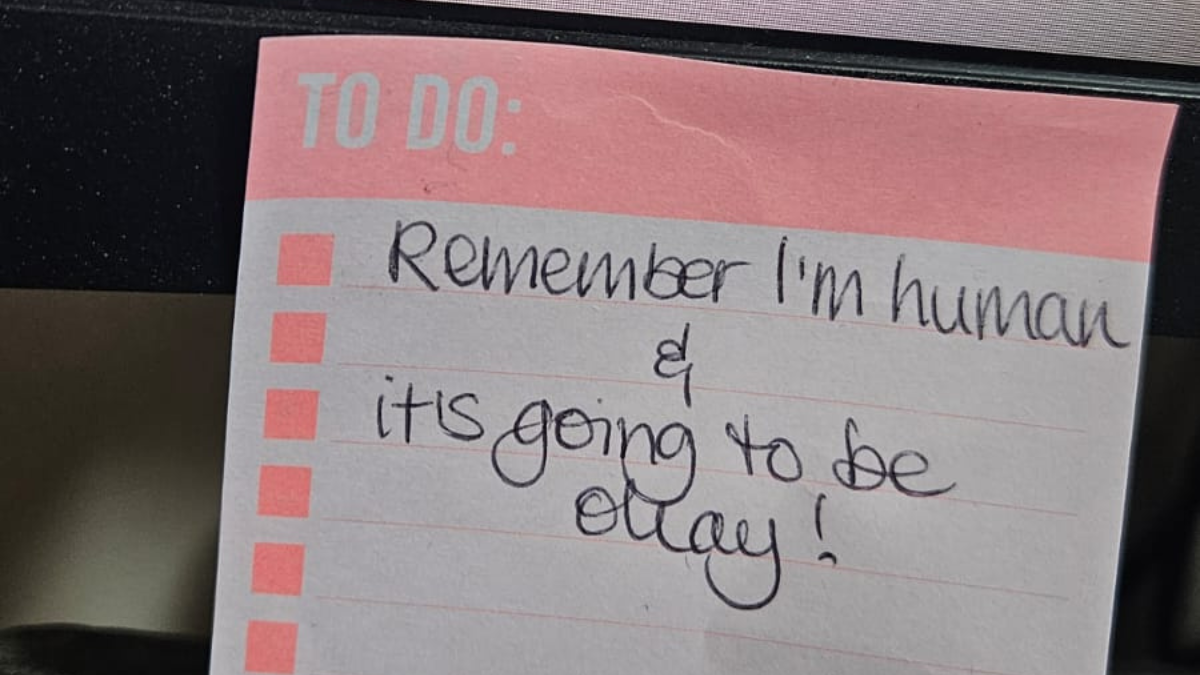
It can help to write these words down, to Post-It them to your screen or mirror, to say them out loud. Practice them. The more we use the words, the easier they will roll off your tongue when you need them. I promise you, your nervous system will hear it and your body will thank you for it.
I would love to hear from you, if this resonates with you or if you've tried some of the sentences. Feel free to reach out by replying to me via email: biddy@yogawithbiddy.com.
Take care of yourself, and in case you find it hard to say let me tell you: You are awesome.
With love, Biddy
Is self-talk something you’d like to explore together?
Book a free call here to see if we can work together!
You can also book a private session or join my membership.
Check out my video thesis on self-talk here:
This article was also sent out as a newsletter. My plan is to write articles and letters like this about topics that I’m passionate about more regularly. I hope you will enjoy them! If you would like to receive the letters in your mailbox, click here to subscribe.