From searching pain relief, to finding a life changing practice
 Biddy Messchaert
- or how I fell in love with my yoga practice. Discover how a persistent wrist injury led to an unexpected journey to yoga and a new life path.
Hi, I’m Biddy. A yoga therapist, teacher and teacher trainer. In these articles, I talk about my work and the things I discover, see and notice. The things I am passionate about or surprised by.
This article takes approximately 9 minutes to read & is also available as a podcast! Listen here:
From searching pain relief,
to finding a life changing practice
- or how I fell in love with my yoga practice
Yoga and I had an on-and-off-again relationship. I tried it a few times, but I never felt that click with the practice that would make me come back. I found my love for the practice when I was in my mid thirties. Looking back it would have been amazing to have had this practice and all its benefits earlier in life. Yet I also believe I found it at exactly the right time. Any sooner, I would not have been open to the practice and the beauty it now brings to my life. It wouldn’t have had the same effect, and I probably wouldn’t have been writing this story.
I had always been someone that pushed through any limitations my body gave me. I had headaches for as long as I can remember and I was diagnosed with migraines when I was 6. I found those headaches annoying, and yet I accepted them as a fact of life. Because my hypermobility was not diagnosed until I hit my forties, joint pain and joint injuries were also always with me. Those were annoying too; they were disruptive to my daily life, sometimes incredibly painful. I felt my body and I were in a constant battle, and in my mind, that just meant I needed to push myself harder. To the limit, and often over. This battle, between what I wanted and what I was physically able to do, was exhausting.
The injury that stopped me
I ended up with a wrist injury that was with me for years.
My husband and I had been doing some DIY at our home, and one afternoon I was putting the roof tiles he was handing me from our roof, down on the ground. The next day, my wrist was swollen and an inflammation started. I did not know it then, but this was the beginning of a long journey where I wasn’t able to simply push through. I could not type, use my laptop, hold a book, play the guitar, play videogames. Those were the things I both loved and spent a lot of time doing. Voice recognition and AI were not where they are today, which made working challenging - if not impossible. To say I was frustrated is an understatement.
I went through the hoops: The standard paracetamol the GPs in the Netherlands prescribe for everything, rest, braces, physiotherapy - so much physiotherapy. Nothing helped. I was losing patience and wanted to get on with life. The pain kept me awake at night, and losing sleep does not make a person more patient. I felt hopeless.
The way through
Then a stroke of luck came. After over a year of pain, I finally found a surgeon that was honest and excellent at his job. He came with a reputation that brought me hope: If anyone could help, this man seemed to be the one. He started with a surgery trying to support the tendons in my wrist. That did improve my wrist a little, but it still didn’t heal. While I was able to do certain movements better, like zipping up my trousers and putting my hair in a ponytail, there was still a lot of pain. I could not bear weight on it, hold a book, or type with my left hand. This is almost two years after my original injury doing our work on the roof.
There was one more option left. The surgeon was hopeful it would help with the pain, but he was not sure if I would be able to bear weight or do the things I loved doing after this surgery. Since I wasn’t able to do these things anyway, we decided to go for it. Under local anesthetic, my ulna - the bone in your lower arm on the pinky side - was shortened. It had been pushing into my wrist joint, most likely due to my hypermobility, and it was causing chronic inflammation.
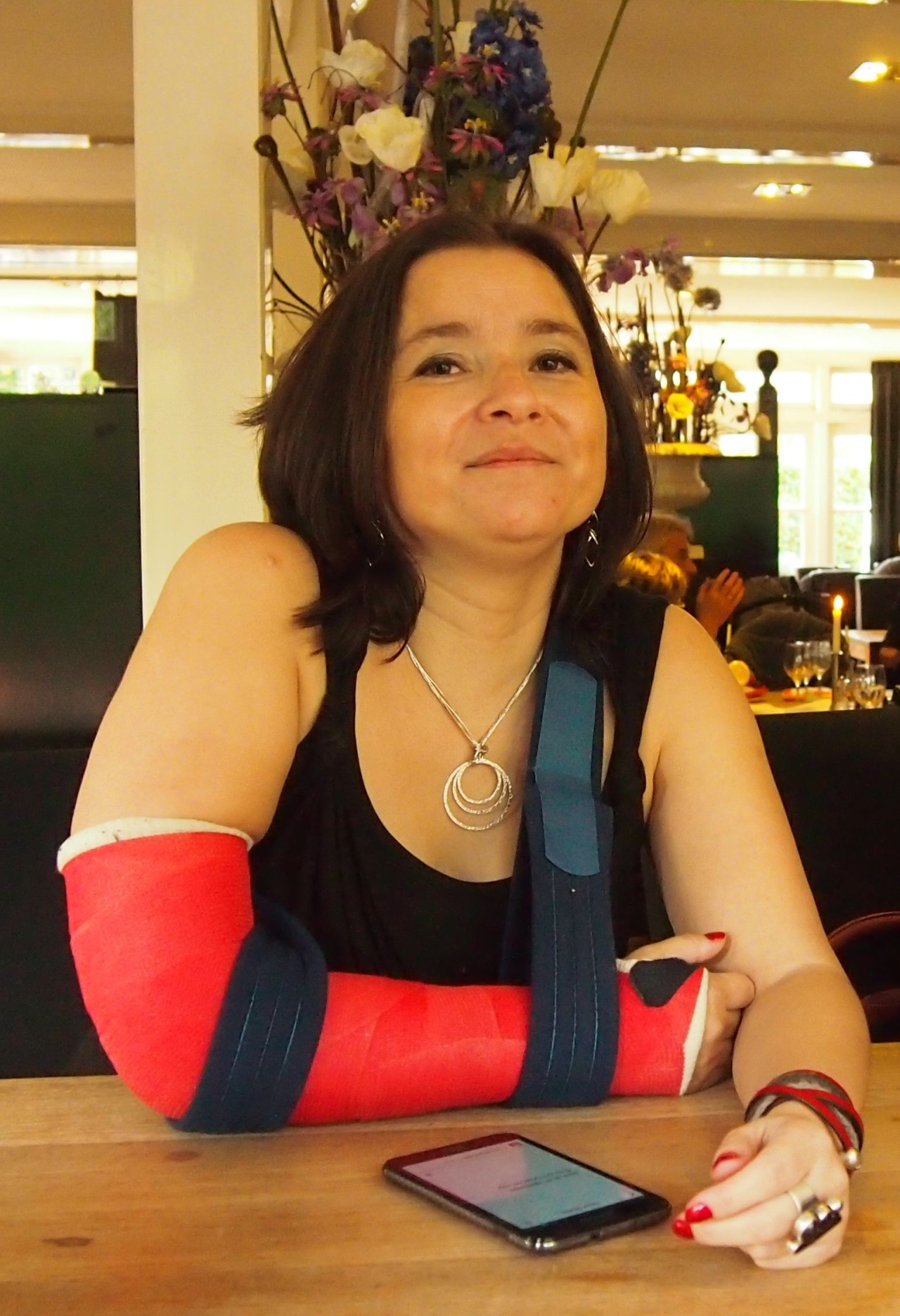
After this surgery, my wrist functionality started to improve slowly. I experienced less pain in rest, and little by little, with a lot of physiotherapy and training, I was finding more mobility.
Adding insult to injury
All throughout this journey with my wrist, my lower back had been painful. With all that I know now, I understand that having an injury in one part of your body has a chain effect; your posture changes to accommodate movement through your life with as little pain as possible. Do that for a little while and chances are you will be fine. Do it for a long period of time, it might cause a whole new set of injuries and problems.
With my wrist slowly improving, my back pain became more apparent. My physiotherapist recommended I try yoga for my lower back pain, and the rest is history.
History in the making
Well, for me it’s history. For you, this is where the story is going. I googled yoga for lower back pain and I found a teacher I liked. She was funny, kind, and she had a way to guide me through poses that felt natural and fun. The added bonus was that she was available whenever I wanted and she came right into my home. Yoga with Adriene found the right words, the right tone, the right jokes to make me feel at home in my yoga practice.
Suddenly, my on and off relationship with yoga changed into a dedicated one. I would roll out my mat daily and my practice time became my favorite time of day. Until then, I’d never really had a practice that asked me to move with intention.
I used to dance, where I was asked to move to the music, in sync with my fellow dancers.
I had gone to the gym, where I moved to try to not think and not feel pain.
And here was Adriene, giving me moments on a mat bringing awareness to my own body in a way that I actually didn’t mind. Up until then, being aware of my body was not a pleasant thing to do. It would make me notice where I hurt, and add to a feeling of helplessness. Through my practice I discovered a way to bring awareness without judgement. There was this reassurance that I did not have to feel a certain way. I was invited to show compassion for the parts of me that I had been angry with for so long. I learned that I didn’t have to do things that did not feel right, while making sure I also knew it was okay to not know what felt right.
The practices frustrated me at times too. They showed me what I couldn’t do, just as much as what I could do. I spent a lot of time just listening to the videos, thinking I would never be able to do them. A lot of the practices were done on hands and knees and my wrist was nowhere near ready to be in that position.
Getting to know me
Before starting a yoga practice, I had been separating my body from the rest of me. That is how I talked about myself and how it felt: There was me, Biddy, that wanted to do all these things, and there was my body; stopping me, limiting me. My practice was slowly teaching me that my body and all its pains and discomforts were part of me. It was showing me that just maybe, this was an intuitive part of me, communicating to the rest of me that I was asking too much of myself. It was warning me that my pushing through limits was hurting me.
My practice started showing me that I am my body. It might sound so logical to you that it’s weird to hear me talk like this. Or maybe you recognize this way of thinking? As I noticed this shift, I started wondering: Could my expectations be the cause of my frustration? Could they possibly be a little unrealistic at times? Was I maybe asking too much, instead of my body giving too little? Might my energy be too low to do the things I thought I “should” be able to do?
I started listening. I’m not saying I enjoyed what I was hearing. But I did start to realize that my body, my intuition, had very accurate insider information about what is happening to all of me at any given moment.
Until then, I had been very good at focusing on what I thought I should be able to do, often also mirroring what I saw other people around me doing. I “should” be able to type with two hands. I “should” be able to read hard cover books, not paperbacks or use an e-reader.
I wanted to be able to work and be great at my job without pain. I wanted to do this thing called life, like a healthy person my age did.
A shift
My practice made me connect to my inner world. It helped me understand that my wrist, and therefore my body, in all its strength and limitations, was doing its best to make sure I could do all I wanted to do. It was warning me when I was overstretching myself (both physically and mentally), and it got hurt when I didn’t listen.
Let me rephrase that: I was warning me when I was overstretching myself, and I got hurt when I didn’t listen.
The wisdom of the mat, or my own wisdom showing itself on the mat?
When I was moving on my mat, I was invited to notice how my body felt as I did. It was easier to notice where I felt pain or stiffness. There were times I lay on my mat crying because my wrist was so painful I could not be on hands and knees for even a second. There were times where I felt weak and like a failure because I was exhausted three minutes into my practice.
But after a while I also started noticing the places I felt comfortable and where movement felt smooth. Somehow, my mat and my teacher both felt like a place of comfort; a place where it was okay to cry, be angry, be frustrated. And once I started to make space for that, it also became easier to notice all the parts of me that were functioning well, that were able to do the things I wanted. I started to also see the more positive parts of myself again.
From moving with pain to the magic of cat/cow
When pain is chronic, it tends to take the lead role in your life. It makes it harder to be aware of the parts in you that might actually feel good. When I started moving in Cat/Cow, for the first time in a long time I realized that alongside the pain I could find comfort. Yumminess even! It quickly became my favorite pose.
Something about moving my spine to the rhythm of my breath felt like magic. It calmed me down, helped me worry less, and be in the moment more. It was a movement that I could always do, no matter how tired I felt or how much pain I experienced. This movement became a daily companion.
When my wrist was painful, or on days where I had done physiotherapy and couldn’t not ask my wrist to do more, I would do it seated on my mat. I now know how important it was that I had found a teacher who showed so many variations of the same pose or movement, and who asked me to choose the one that felt comfortable. On the mat, I was letting go of the shoulds. I also kept trying how it felt on hands and knees. I started to recognize that on days where I felt tired, or had been typing at my computer, choosing the seated version allowed me to focus on the movement of my spine and my breath instead of feeling my wrist. I also noticed that I would move on to hands and knees more instinctively on the days where I had more strength in my wrist.
After a while, cat/cow became like a barometer. If it felt stiff and smaller movement felt better, it usually meant that I needed a little more kindness to myself in general at that moment. It could indicate that I was tired or had asked too much of myself. Slow breathing practices usually felt good at those moments. If it felt like the sky was the limit, it usually also meant that I felt better in my skin, I had more mobility and space to breathe.
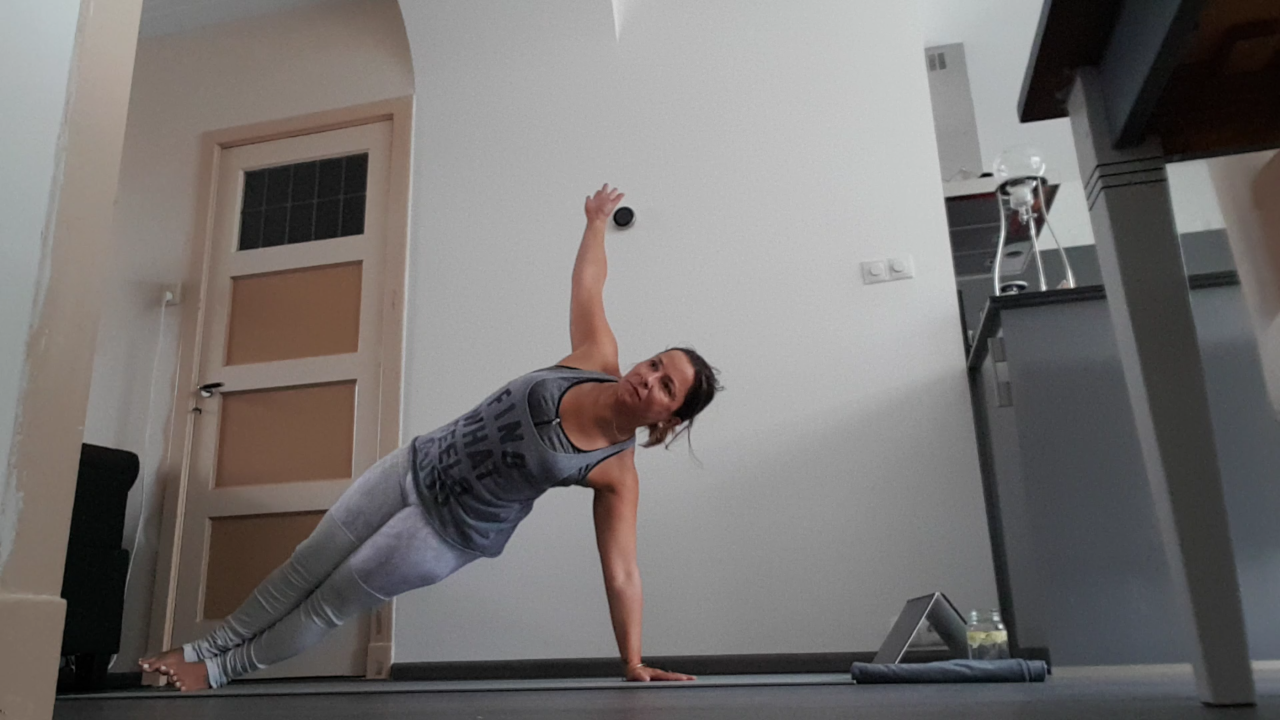
Little by little, my wrist was able to bear more weight. Once I noticed that, I needed to remind myself to build up slowly, to not take things too far too fast. My yoga practice helped me there too, because it asked me to notice how my body felt and how busy my mind was. It helps to be aware of these things when you are someone that used to push herself over the limit. After all, Biddy before yoga did not really recognize that there was a limit, just an annoying body.
Fast forward to months later where I was able to show my surgeon a photo that even surprised him:
From a lower back practice to a new state of mind
Feeling myself grow stronger, feeling my back pain subside were big reasons for me falling in love with a regular yoga practice, but what made me stay was something deeper.
As my wrist became stronger and the pain slowly left, I did not roll up my yoga mat like I stopped my rehab exercises from my physiotherapist. It was the unexpected mental and emotional changes that came with my practice that made me return to my mat long after that.
I used to always feel rushed. I needed to do everything as soon as possible (preferably sooner). That rushed feeling started to subside as my yoga practice grew. I used to find it hard to sit still, and now I could sit or lay down on my mat and listen to a yoga practice on days where physically moving did not feel doable. I would even enjoy that! I started to feel calmer and now, looking back, I would say I was able to be more present in the here and now. To not be planning ahead, solving potential future problems, or to be frustrated by not being able to do something I wanted to do. I more often found myself being okay with being here.
Has this change now become a permanent state of mind? No.
Did I never feel rushed since practicing yoga? Hell no.
Did it change me significantly and lastingly? Oh yes, did it ever.
My daily practice has changed since. My view on yoga has changed since. My love for yoga has only grown deeper. Back then, I did not quite understand why 10 to 40 minutes on a yoga mat regularly had such a big effect on me, even on the days I didn’t move but “just sat there.” But because it did have such a big effect on me, I said yes to my first yoga teacher training. Not because I wanted to be a teacher - everyone around me and even I agreed that I was way too impatient for that. But I wanted to understand why the effect of time on my mat was so big.
I’ve learned so much since then and eventually this journey brought me to becoming a yoga teacher and therapist. It brought me here to write this letter. It gave me the insight that the learning and discovering new things about yourself never stops. Even as teachers and therapists, we always – always – remain students too.
Practice cat/cow with me
I have a short practice for you: Join me and let’s explore cat/cow together.
As you practice, notice: Which version of cat/cow felt best for you today? Did you enjoy linking the movement to your breath? As I often say in class, it doesn’t have to be a big move to have a big effect. I think honoring the boundaries your body gives you, as an act of self love. I know this is controversial, as many people say that growth happens outside your comfort zone, but let’s save that discussion for another time. For now, I promise you that even laying down on your mat and listening to the practice will have an effect on you. It starts with allowing yourself to open up to that possibility and noticing it.
I would love to hear from you – reply to this email and let me know how this practice felt!
As always with love,
Biddy
Are the benefits of a yoga practice something you’d like to explore together? Book a free call here to see if we can work together!
You can also book a private session or join my membership.
This article was also sent out as a newsletter. My plan is to write articles and letters like this about topics that I’m passionate about more regularly. I hope you will enjoy them! If you would like to receive the letters in your mailbox, click here to subscribe.